Bengaluru rooftop solar · expanding across Karnataka

Energy, Reimagined

Your roof already receives the sunlight. Let’s start using it.

We design, install and commission rooftop solar systems sized around your actual electricity consumption — then handle the BESCOM paperwork and the PM Surya Ghar subsidy application on your behalf.

  • Systems sized to your bill, not to a sales target
  • End to end: design, installation, approvals, commissioning
  • Free consultation and site assessment

Suryonix is a BESCOM & PM Surya Ghar empaneled vendor

Book your free solar consultation

Tell us what you spend each month. We’ll tell you what solar would do about it.

Please enter your name.
+91
Enter a 10-digit mobile number starting with 6, 7, 8 or 9.
Enter a 6-digit Karnataka pincode.
Average monthly electricity bill
Select your approximate monthly bill.

No obligation. We’ll call you within one working day.

Request received

Thanks — we’ll call you within one working day to arrange your free assessment.

Continue on WhatsApp
The case for solar

Why go solar?

Electricity is one of the few household costs you can actually stop paying. Here’s what changes when your roof starts generating.

  • Your monthly bill drops

    A correctly sized system offsets a large share of your daytime consumption. What you don’t draw from the grid, you don’t pay for.

  • Protection from tariff rises

    Grid tariffs revise upward over time. Sunlight does not send revised tariff orders.

  • You generate, not purchase

    During daylight hours your appliances run on electricity your own roof produced.

  • Surplus goes back to the grid

    Under net metering, units you export are credited against units you import — so daytime generation offsets night-time use.

  • Government subsidy for homes

    Eligible residential consumers can claim central assistance under PM Surya Ghar. Exact figures are in the subsidy section below.

  • It asks almost nothing of you

    No fuel and no moving parts in the panels. Periodic cleaning and an occasional check.

  • A two-decade asset

    Panels are supplied with long-duration performance warranties. This is not a two-year gadget.

  • Clean generation

    Every unit generated on your roof is a unit that didn’t need to be produced elsewhere.

Why Suryonix

Solar is a 25-year asset installed in a few days

Who installs it, and how, determines what the next twenty-five years look like.

Suryonix is a BESCOM & PM Surya Ghar empaneled vendor

  • End-to-end delivery

    Consultation, consumption analysis, design, supply, installation, commissioning and handover. One team, one point of accountability. We don’t sub-contract your project to whoever is free that week.

  • Engineering-led installation

    Mounting rated for local wind loads. Correct cable sizing, proper earthing and protection. The parts of a solar installation you never see are the parts that decide whether it lasts.

  • Sized to your consumption

    We read your bill before we quote. An oversized system wastes your capital; an undersized one leaves you still paying the grid. The right answer comes from your usage, not from a price list.

  • Components chosen to be serviceable

    We select on warranty terms and service presence, not landed cost alone. A cheap inverter with no service network in Karnataka is not cheap.

  • Transparent pricing

    An itemised quotation: what the system includes, what it excludes, what the subsidy covers and what you actually pay. No line items that appear after you’ve signed.

  • BESCOM and subsidy assistance

    Application, approvals, net-metering coordination and the PM Surya Ghar claim. This is the part customers find most tedious, so we handle it.

  • Support after commissioning

    Post-installation service, performance checks, and a team that answers the phone after the invoice is paid.

  • Warranty coordination

    If a component fails within its warranty period, we handle the claim with the manufacturer. You should not have to negotiate with a panel factory.

The basics

How a rooftop solar system actually works

Five stages. No jargon.

  1. 1. SunlightFree, every day
  2. 2. Solar panelsMake DC power
  3. 3. InverterDC becomes AC
  4. 4. Your buildingUses it first
  5. 5. The gridTakes the surplus — credited back at night

Worth knowing before you buy: a standard on-grid system shuts down during a power cut. That is a safety requirement, not a fault — it stops your system feeding electricity into lines that technicians may be repairing. If you need power during outages, that requires battery storage. Ask us and we’ll explain the trade-offs honestly.

What we install

Our solar solutions

Residential

Homes, villas and apartment terraces

  • Independent houses
  • Villas
  • Row houses
  • Apartment terraces

Homes are where the subsidy applies. Eligible residential consumers can claim central assistance under PM Surya Ghar, which changes the economics substantially. We size the system to your household’s consumption pattern and handle the BESCOM process end to end.

Get a residential solar quote
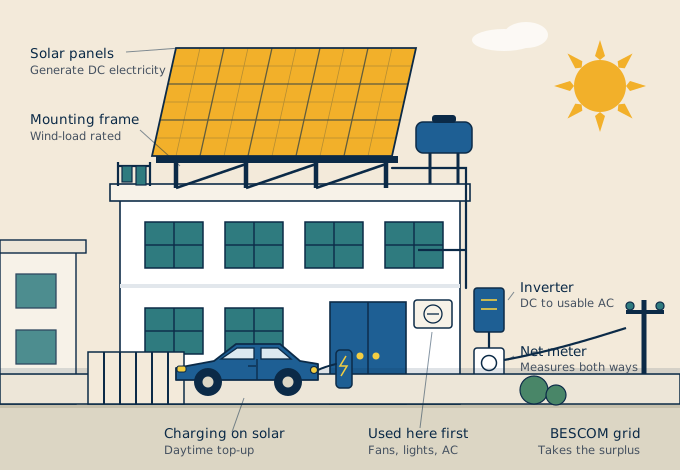
A Bengaluru home with solar panels on a raised mounting frame over the terrace, an inverter and net meter on the outside wall, and an electric car charging outside.
Commercial

Offices, retail, hotels and institutions

  • Offices
  • Showrooms
  • Hotels
  • Hospitals
  • Schools

Commercial tariffs are higher than domestic ones, so every unit generated on your roof displaces a more expensive unit. Businesses also consume most of their electricity during daylight — precisely when a solar system generates. That alignment is what makes commercial solar work.

Talk to a solar expert
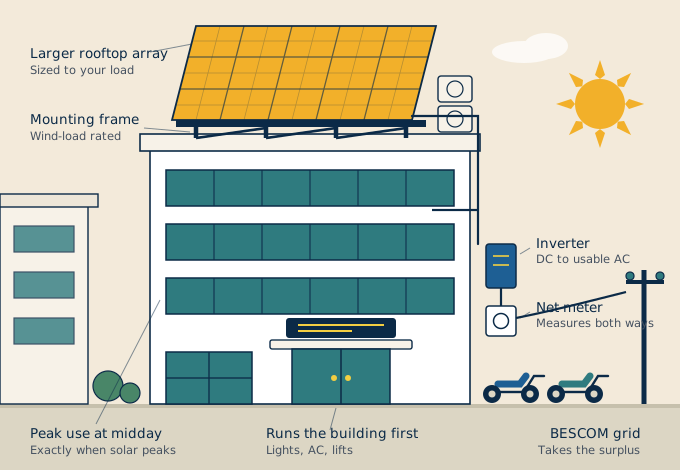
A four-storey commercial building with a large solar array on the flat roof, labelled to show that peak electricity use at midday coincides with peak solar generation.
Industrial

Factories, warehouses and high-consumption facilities

  • Manufacturing units
  • Warehouses
  • Cold storage
  • Processing plants

At industrial scale, electricity is a line item on your P&L rather than a household expense. A rooftop system converts part of that recurring operating cost into a one-time capital asset with predictable output for decades. We assess roof structure, available area, load profile and sanctioned demand before proposing capacity.

Discuss your solar project
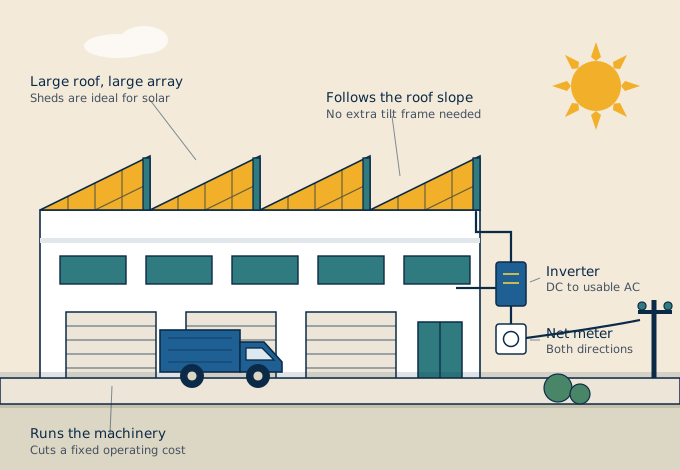
An industrial shed with a saw-tooth roof, each sloping face covered in solar panels mounted flush to the roof slope, with the inverter and net meter on the end wall.
How we work

From first call to a system feeding your meter

Seven stages. You’ll know which one you’re in at any point.

  1. 1

    Free consultation

    Share your details and what you spend monthly. We call you to understand the property and what you’re trying to achieve.

  2. 2

    Electricity bill analysis

    We examine your consumption pattern — not just the amount, but when and how you use power. This determines the right capacity.

  3. 3

    Site assessment

    We visit. Roof area, structure, orientation, shading through the day, cable routing, inverter location and safe access for maintenance.

  4. 4

    System design and proposal

    A recommended capacity with an itemised quotation: components, expected generation, applicable subsidy and your actual net cost.

  5. 5

    Installation

    Mounting structure, panels, inverter, DC and AC protection, earthing and cabling — installed by our own team.

  6. 6

    BESCOM and subsidy process

    Application, inspection coordination, net-meter installation and the PM Surya Ghar subsidy claim.

  7. 7

    Commissioning and ongoing support

    System energised, generation verified, handover with documentation — then continued support, service and warranty coordination.

Coming soon

Solar savings calculator

We’re building a calculator that estimates your recommended system size, expected monthly generation, likely savings and payback period from your bill and location.

Until it’s live, the fastest way to get those numbers is to ask us. Tell us your monthly bill and we’ll work them out for your specific case — which will be more accurate than any calculator anyway.

Get my estimate
Components

What goes onto your roof

A solar installation is six or seven components working together. Here’s what each one does and why it matters.

  • Solar panels

    Convert sunlight into DC electricity. They sit outdoors for decades through monsoon and summer, so build quality and warranty terms matter more than peak wattage on a datasheet.

    • Waaree
    • Adani Solar
    • Tata Power Solar
  • Solar inverter

    Converts DC into AC and manages how the system interacts with the grid. It works hardest and is most likely to need service — which is why service presence in Karnataka matters when selecting one.

    • Luminous
    • Deye
    • Amaze
  • Mounting structure

    Holds the panels at the correct angle through wind and rain. It must be engineered for local wind loads and must not compromise your roof’s waterproofing. Under-specified structures are among the most common failures in low-cost installations.

  • Electrical protection

    DC and AC protection, proper earthing, surge protection and correctly rated disconnects. None of this is visible in a photograph of a finished installation, and all of it is what stands between a rooftop DC array and a fire.

  • Monitoring

    Modern inverters report generation to an app, so you can see what your system produced today, this month and this year — and notice quickly if something isn’t right.

We select components on warranty terms, ALMM listing and service presence in Karnataka rather than on landed cost alone. The right brand for your system depends on your capacity, roof and budget — we’ll explain the trade-offs when we quote, not simply supply whatever we have in stock.

PM Surya Ghar

Government subsidy for home solar

Eligible residential electricity consumers can claim Central Financial Assistance under the Government of India’s PM Surya Ghar: Muft Bijli Yojana.

We are a BESCOM & PM Surya Ghar empaneled vendor. The scheme requires you to choose an empaneled vendor for your claim to be valid — so with us, that box is already ticked. We handle the entire process on your behalf: portal registration, DISCOM approval, inspection and net metering.

Central subsidy by system capacity
System capacityCentral subsidy
1 kW ₹30,000
2 kW ₹60,000
3 kW and above ₹78,000 max

How it’s calculated: ₹30,000 per kW for the first 2 kW, plus ₹18,000 for the third kW. Capped at ₹78,000 regardless of how large a system you install.

Three things worth knowing upfront

  • 1This is for residential consumers. Commercial and industrial installations are not covered by this residential assistance.
  • 2It is not an upfront discount. The subsidy is credited to your bank account after installation and DISCOM commissioning — so your initial payment is for the full system cost.
  • 3The prescribed process must be followed — portal registration, DISCOM approval, inspection and net metering — for the claim to be valid.

How the subsidy process works

  1. Check eligibility
  2. Register on the portal
  3. Select DISCOM
  4. Choose an eligible vendor
  5. Install the system
  6. Inspection & net metering
  7. Verification
  8. Subsidy credited

Karnataka: PM Surya Ghar applies to eligible residential consumers in Karnataka through the DISCOM process. For Bengaluru, that is BESCOM. For eligible residential customers in Karnataka, the applicable rooftop solar subsidy currently includes the Central Government’s PM Surya Ghar: Muft Bijli Yojana. Any additional state-level incentives, if introduced or applicable, will be subject to the latest government and DISCOM guidelines.

Disclaimer: Subsidy information is based on the latest available government guidelines and is subject to change. Eligibility, subsidy amount and approval are subject to applicable government regulations, DISCOM verification and the customer’s individual circumstances. Figures last verified 9 August 2026.

Check my solar subsidy eligibility Tell us your monthly bill and we’ll estimate what you’d save.
Answers

Frequently asked questions

The questions we’re asked most often, answered plainly.

How much does a rooftop solar system cost?

Cost depends on capacity, panel and inverter selection, roof type and the mounting structure your site needs — a flat terrace and a sloped tiled roof are different jobs. For homes, the PM Surya Ghar subsidy reduces your net outlay considerably.

We don’t publish a price list, because a number quoted before anyone has seen your roof or your bill is a guess. Instead our team prepares an itemised quotation after the free site assessment — components, capacity, applicable subsidy and your actual net cost, all in writing. Book a free consultation and we’ll get you a real figure.

What size system do I need?

That comes from your consumption, not from your roof size. We read your electricity bill to understand how many units you use and when. As a rough guide, homes commonly install between 1 kW and 5 kW. Your actual number comes from your bill.

How much roof area does it take?

Broadly, around 80 to 100 square feet of shadow-free area per kW, depending on panel wattage and layout. A 3 kW system therefore needs roughly 250 to 300 square feet. We confirm the exact area during the site assessment.

How much will I actually save?

Your system offsets the units you would otherwise buy from BESCOM. How much that saves depends on your consumption, your tariff slab and how much of your usage falls during daylight. We calculate this for your specific bill rather than quoting an average that may not apply to you.

How long does installation take?

The physical installation of a typical residential system takes a few days on site. The full timeline is longer because of the approval stages that follow, which run on BESCOM’s schedule rather than ours.

Realistically: application and approval, installation, then inspection and net-meter installation together usually run around four to ten weeks from booking. The PM Surya Ghar subsidy is then credited roughly four to seven weeks after commissioning.

Some installations move faster than that and some take longer — delays almost always occur at the DISCOM inspection or metering stage, which no installer controls. You will hear from us where your file actually is rather than being told it’s “in process”.

What happens during a power cut?

A standard on-grid system shuts down during an outage. This is a safety requirement, not a fault — it prevents your system from feeding electricity into lines that technicians may be repairing. If you want power during cuts, that needs a hybrid inverter with battery storage, which adds cost. We will explain the trade-off honestly rather than sell you a battery you may not need.

What is net metering?

A bi-directional meter installed by BESCOM records both the electricity you draw from the grid and the surplus you export. You are billed on the net. In practice, the surplus your roof exports during the day offsets what you consume after dark.

Is my roof suitable for solar?

Most are. What matters is shadow-free area for most of the day, roof structure and condition, orientation and safe access. Heavy shading from a neighbouring building or tree is the most common disqualifier. The site assessment answers this definitively, and it is free.

How long do solar panels last?

Panels from established manufacturers typically carry a product warranty of around 10 to 12 years and a linear performance warranty of 25 years, guaranteeing a minimum output level at year 25. Output declines gradually rather than failing suddenly. The inverter has a shorter service life than the panels and may need replacement once during the system’s life — worth budgeting for.

What maintenance does a solar system need?

Periodic cleaning of the panels, more frequently in dusty conditions or before the monsoon, plus occasional inspection of mounting, wiring and connections. There are no moving parts in the panels themselves. Monitoring through the inverter app tells you if generation drops unexpectedly.

Is a government subsidy available?

Yes, for eligible residential consumers under PM Surya Ghar: Muft Bijli Yojana — ₹30,000 for 1 kW, ₹60,000 for 2 kW, and ₹78,000 for 3 kW and above, capped at ₹78,000. It applies to residential connections only, not commercial or industrial.

When do I receive the subsidy money?

After installation and DISCOM commissioning, credited directly to your bank account. It is not an upfront discount — you pay the full system cost first and receive the subsidy afterwards. Anyone telling you otherwise is describing something different from the scheme.

Do I need BESCOM approval?

Yes. A grid-connected rooftop system requires application and approval, followed by inspection and net-meter installation. We handle this process for you, including the PM Surya Ghar portal registration.

Will the installation damage or leak my roof?

It shouldn’t, if the mounting is done correctly. Structures are ballasted or anchored depending on roof type, and penetrations are sealed properly. Water ingress after solar installation is almost always a workmanship problem rather than an unavoidable one.

Can I expand the system later?

Often yes, but it needs planning. Adding capacity later depends on your inverter’s headroom, available roof area and revised DISCOM sanction. If you expect consumption to rise — an electric vehicle, an extra floor, more air conditioning — tell us at design stage and we will size the inverter accordingly. It is far cheaper than retrofitting.

Does solar work during monsoon and cloudy weather?

Generation drops on overcast days but does not stop; panels respond to daylight, not direct sun alone. Annual estimates already account for seasonal variation, and net metering smooths the difference — surplus banked in sunny months offsets the leaner ones.

Can apartments and housing societies install solar?

Yes, where roof rights and society approval allow. Common-area consumption — lifts, pumps, corridor lighting, water treatment — is often the strongest case, since it runs during the day. The approval process differs from an independent house, so talk to us about your society’s specific situation.

Still have a question? Ask us directly

Ready to reduce your electricity bill?

Book a free assessment. We’ll look at your consumption, your roof and your options, and tell you honestly whether solar makes sense for you — including if it doesn’t.

Chat on WhatsApp

Pick who you’d like to speak to.